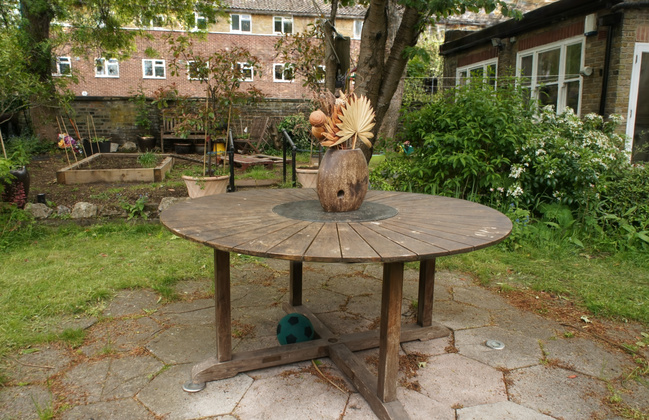
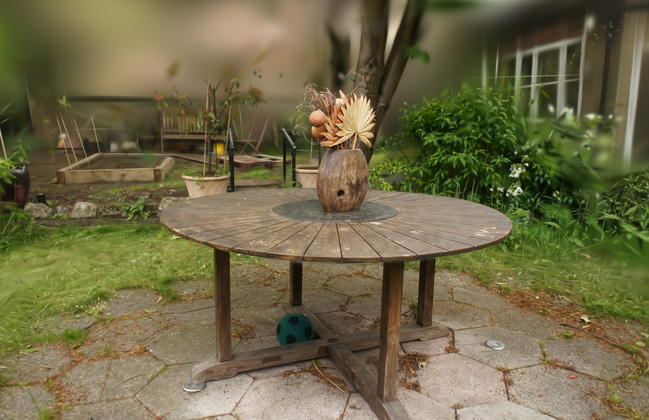
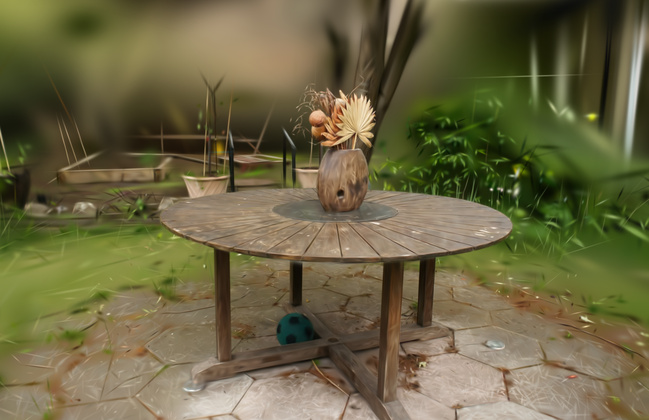
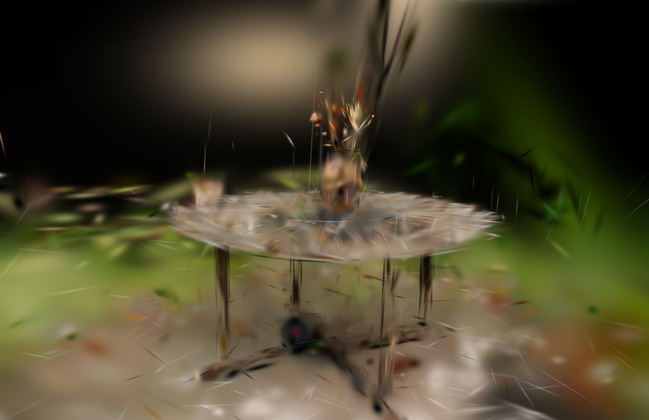
Starting from the same full model, retain 0.1%–100% of its Gaussians as needed, without retraining.
Full100%
24.81dB
The same full-model input
→
5%
1%
0.1%
Method / total training
19.96dB
18.63dB
12.90dB
23.59dB
21.82dB
20.03dB
FlexGS-imp
Total training
123.0min
Switch38.33ms
ParetoGS
Total training
13.5min
Switch0.47ms
Garden · The same test view. Image labels show PSNR (dB); higher is better.FlexGS-imp starts from the shared full model. Total training includes initialization; save-time accounting follows the original records.Switching time is the median over 108 Garden requests, in milliseconds (ms). RTX 4090, model and anchors resident in GPU memory; parameter preparation only, excluding loading and rendering.Explore more budgets ↓
01 / Motivation & insight
One scene. How many Gaussians do you need?
3DGS represents a scene with many small ellipsoids, each with color, shape, and opacity. The budget K is the number of retained Gaussians; percentages are relative to the full model. One scene asset can serve different device capabilities or changing runtime resources.
Three ways to adapt count and parameters
CLOD and MGS share parameters across budgets and select ordered prefixes. Optimizing each budget independently requires building separate models. The following approaches all adapt parameters as the count changes, but place the cost at different stages.
Train budget-conditioned networks to select Gaussians and predict geometric changes. Once built, the model supports inference at different budgets without retraining for each one.
Main cost: adaptation training. The selection and transformation networks require training; total offline time is longer in our experiments.
Merge nearby Gaussians and recompute their parameters to obtain a target count directly from an existing model, without training.
Main cost: target-model conversion. A budget model that has not yet been prepared requires simplification computation. Table 2 reports this conversion time.
ParetoGS · Store adapted states
Directly optimize parameters at a few budgets, then connect the adapted states. Decode the requested budget after construction.
Main cost: extra storage. A residual atlas stores adaptation across budgets to support fast switching.
Training, conversion computation, and storage are distinct trade-offs. Reconstruction quality is a separate comparison: see the images and metrics at matching budgets below.
Why parameters need to adapt
Adapt parameters to the budget.
With fewer Gaussians, each remaining primitive has more of the scene to represent. Its position, shape, opacity, and appearance therefore need to adapt to the budget.
24,000 GaussiansThe same members; only parameters change
Garden · Test view 12
Parameter-source budget
Every image renders the same 24,000 Gaussians; currently using parameters optimized at a 0.8% budget.
02 / Method
Adapt a few anchors. Connect the budgets between them.
We directly optimize parameters at a few budgets, save these states as anchors, and connect them. Intermediate budgets are decoded from neighboring anchors, without training a separate model for every budget.
Build · 01
Prune and adapt progressively
Reduce the count and optimize the surviving Gaussians. Each smaller set is selected from the preceding model.
Build · 02
Align and encode states
Align the same Gaussian identities across anchors. Store their parameter changes relative to the full model in a residual atlas.
Switch · 03
Decode the requested budget
Interpolate shared Gaussian parameters between adjacent anchors. Gate the contribution of entering Gaussians through opacity to produce the requested count.
Scroll horizontally to view the full pipeline ↔
N is the full-model count and K is the requested count. L and U denote the adjacent lower- and upper-budget anchors; S denotes their Gaussian sets. Ellipses of the same color represent the same Gaussian.
03 / Continuous-budget demo
One scene model. A continuous choice of budgets.
Garden · Test view 1 · Full model: 3,000,000 GaussiansAbout 9.5 seconds per clip. Pause or scrub to inspect any point.
04 / Construction & deployment cost
Continuous budgets. What does the flexibility cost?
With 11 budget anchors (including Full) , the residual atlas stores each anchor's parameter changes relative to the full model.
Residual atlas · Mean extra storage85.7 MB
Approximately 21.4% of the original full-model PLY size.
Mean construction time10.3 min
Includes training, encoding, calibration, and packaging.
Budget-switch time2.77 ms
95% of requests take no longer than this (P95). RTX 4090, resident anchors; parameter preparation only, excluding rendering.
Averages cover 13 scenes; additional storage excludes the full-model file.
05 / Experimental results
The full picture, across multiple scenes.
Compare scene reconstructions, mean metrics over 13 scenes, and quality across continuous budgets. Figures and comparison settings follow the paper.
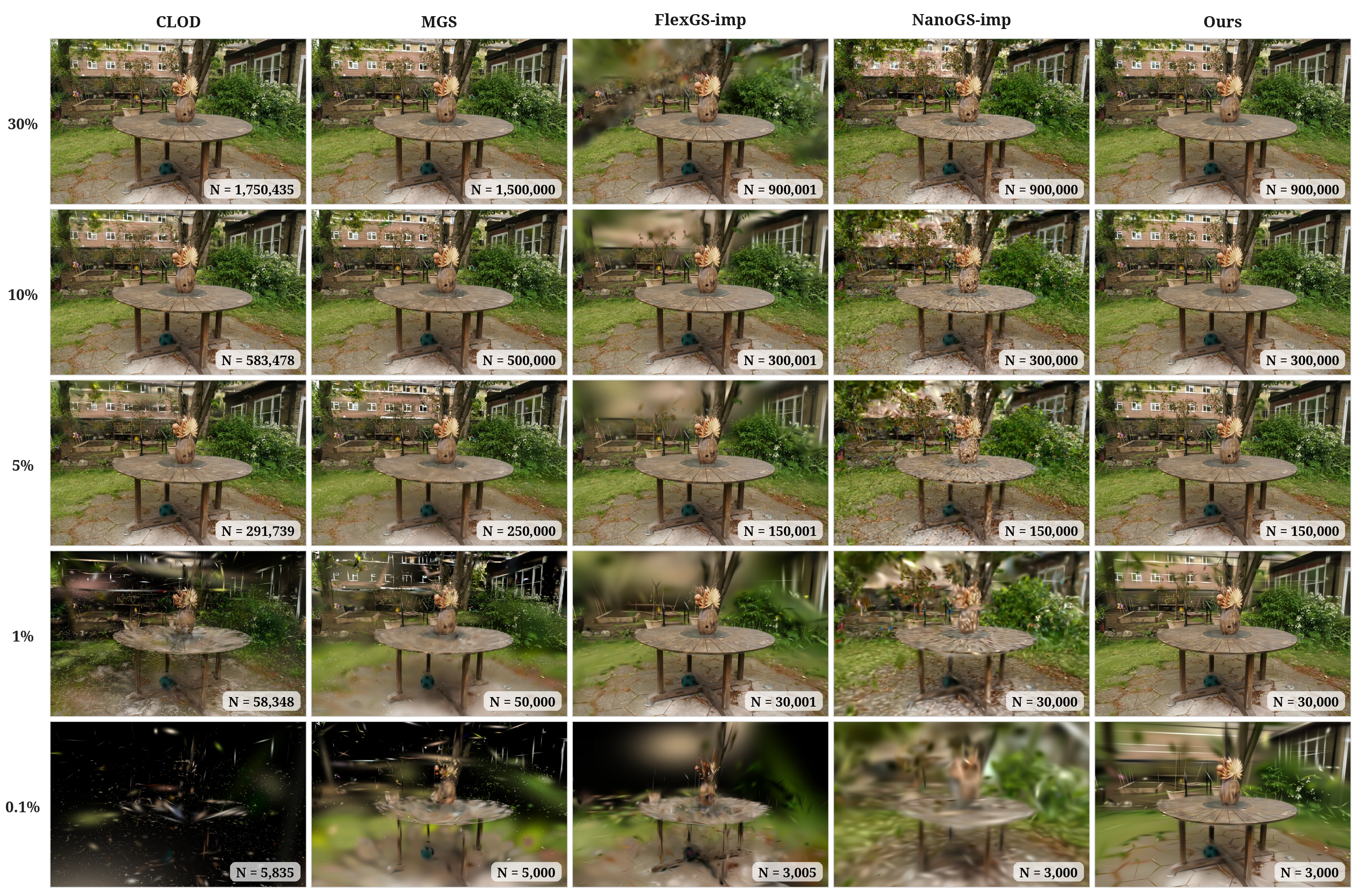
Qualitative results · Five methods
Scroll horizontally to compare methods ↔
Each column is a method; each row is a fraction of its full model. N is the actual Gaussian count; Ours denotes ParetoGS. CLOD and MGS use their own full models, while FlexGS-imp, NanoGS-imp, and ParetoGS share one. Equal fractions need not mean equal counts.
Quantitative results · Means over 13 scenes
Higher PSNR (pixel reconstruction quality, dB) and SSIM (structural similarity) are better; lower LPIPS (perceptual difference) is better. Tables are vector graphics; scroll horizontally on narrow screens.
Table 1 · Shared parameters or budget-specific adaptation?
We use the official CLOD-3DGS and MGS implementations, with MCMC (Markov chain Monte Carlo) densification in this experiment. CLOD fine-tunes sampled prefixes after full-model pretraining; MGS jointly optimizes the full set and sampled prefixes at each step. ParetoGS adapts parameters at a few budgets and connects the resulting states.
This table compares equal fractions of each method's own full model and reports the actual counts. The full-model sizes differ across methods.
Counts are in thousands of Gaussians, as in paper Table 1. Bold marks the best quality metric in each row.
Times beside method names are offline means over 13 scenes. ParetoGS takes about 10.3 minutes for full-model and anchor training, encoding, calibration, and packaging; training accounts for about 9.78 minutes.
Table 2 · Adapting budgets from the same full model
All three methods start from the same ImprovedGS full model and are compared at the same requested counts. FlexGS-imp learns budget-conditioned selection and geometric transforms; NanoGS-imp converts a model offline for each target budget; ParetoGS decodes sparse adapted anchors. The suffix -imp denotes the shared initialization.
FlexGS-imp uses the official code with 35,000 adaptation steps and training budgets of 1%, 5%, 10%, and 15%. The evaluated 0.1% and 30% budgets lie outside this range. NanoGS-imp also uses the official implementation.
Counts are in thousands of Gaussians; NanoGS-imp conversion time is in seconds. Metrics are equally weighted means over 13 scenes. Bold marks the best quality metric in each row.
With a shared full model, ParetoGS outperforms FlexGS-imp and NanoGS-imp on PSNR, SSIM, and LPIPS at all five budgets evaluated in Table 2.
FlexGS-imp's approximately 81 minutes include full-model construction and budget adaptation. NanoGS-imp's 48–56 seconds measure offline conversion from Full to one target model. The demo in Section 03 and millisecond timings in Section 04 concern budget switching after construction.
Quality–budget curves
Inspect quality between anchors against a GNS reference optimized independently at each budget. Curves show means over all test views of the selected scene.
Garden · Mean over 24 test views · Full model: 3,000,000 Gaussians.Blue open circles are optimized anchors; small dots are decoded budgets between them. Orange stars are independently optimized GNS references. Higher SSIM and lower LPIPS are better. The horizontal axis is the actual count as a percentage of Full, shown from 0.1% to 50% on a log scale; lines connect measured points. Scroll horizontally on narrow screens.
06 / Paper & citation
Read the full study.
The paper covers the algorithm, component ablations, and complete per-scene results. A BibTeX entry is provided below.
@misc{deng2026paretogshighqualitycontinuousbudget3d,
      title={ParetoGS: High-Quality Continuous-Budget 3D Gaussian Splatting with Sparse Adapted Anchors},
      author={Xiaobin Deng and Changyu Diao and Min Li and Duanqing Xu},
      year={2026},
      eprint={2610.34235},
      archivePrefix={arXiv},
      primaryClass={cs.CV},
      url={https://arxiv.org/abs/2610.34235},
}